
Candy Hole controls and interface layout
Candy Hole separates pre-round amount controls from live movement, keeping Play, the movable field and Withdraw in distinct interface states.
Candy Hole separates pre-round amount controls from live movement, keeping Play, the movable field and Withdraw in distinct interface states.
Adjust the selected numeric value.
Visible shortcuts are 1, 2, 5 and 10.
Starts the selected round.
Remains available during active movement.
| Interface area | Visible detail | Purpose |
|---|---|---|
| Top left | Balance and back | Session and navigation |
| Top centre | Candy Hole logo | Product identity |
| Top right | Sound and settings | Utility controls |
| Bottom before play | Stake panel | Amount and shortcuts |
| Field during play | Drag movement | Directs the hole |
| Bottom during play | Withdraw | Shows current result |
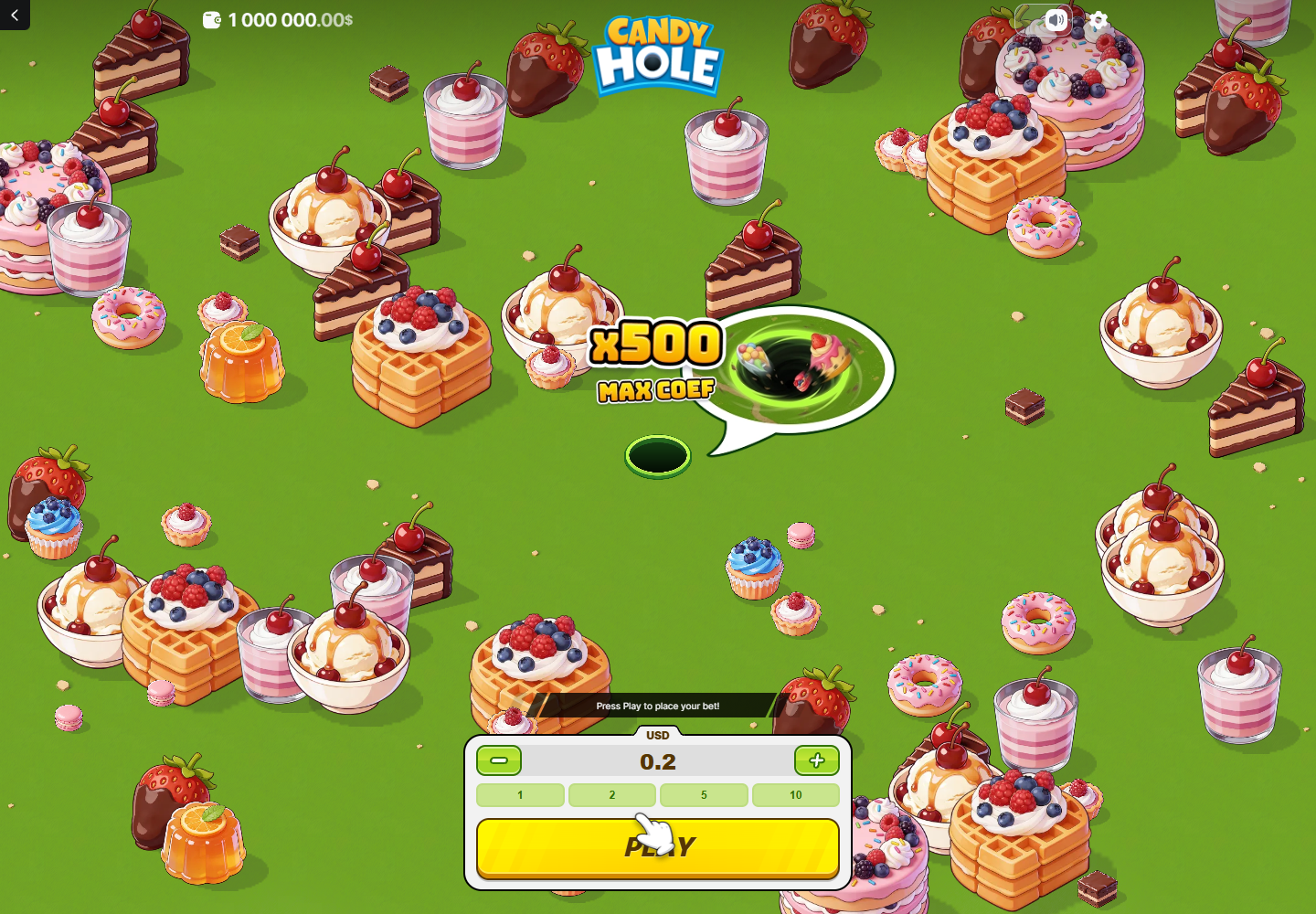
Before a round, the control panel displays the selected currency, a numeric stake, minus and plus buttons, four quick values and a wide yellow Play button. The example screen shows USD and a selected value of 0.2. The panel is centred at the bottom, leaving most of the dessert field visible above it.
The layout separates amount selection from active play. Once Play is pressed, the stake is reflected in the demo balance and the round interface takes over. Large buttons, strong colour contrast and a single primary action make the state easy to recognise on both a desktop browser and a portrait phone.
The visible stake panel includes quick values labelled 1, 2, 5 and 10 in addition to minus and plus controls. These shortcuts sit directly beneath the selected amount. They provide fast access to common values while the increment buttons handle smaller changes and keep the current number centred in the panel.
A selected currency label appears above the amount, helping the control communicate what the numeric value represents. The shortcuts are compact but use consistent widths, so they remain aligned when the interface scales. On mobile, the same row fits beneath the larger amount display and above the full-width Play button.
The example begins with a large demonstration balance displayed at the upper left. When the 0.2 round is launched, the visible balance changes from 1,000,000.00 to 999,999.80. This gives a clear interface connection between the stake panel and the newly active round without opening a separate transaction window.
Balance, logo and utility buttons stay outside the moving play area. Their stable placement makes them readable while desserts and coefficient labels change beneath them. Candy-Hole.com describes the visible demonstration state as a product characteristic and does not present the demo balance as an account deposit or promotional reward.
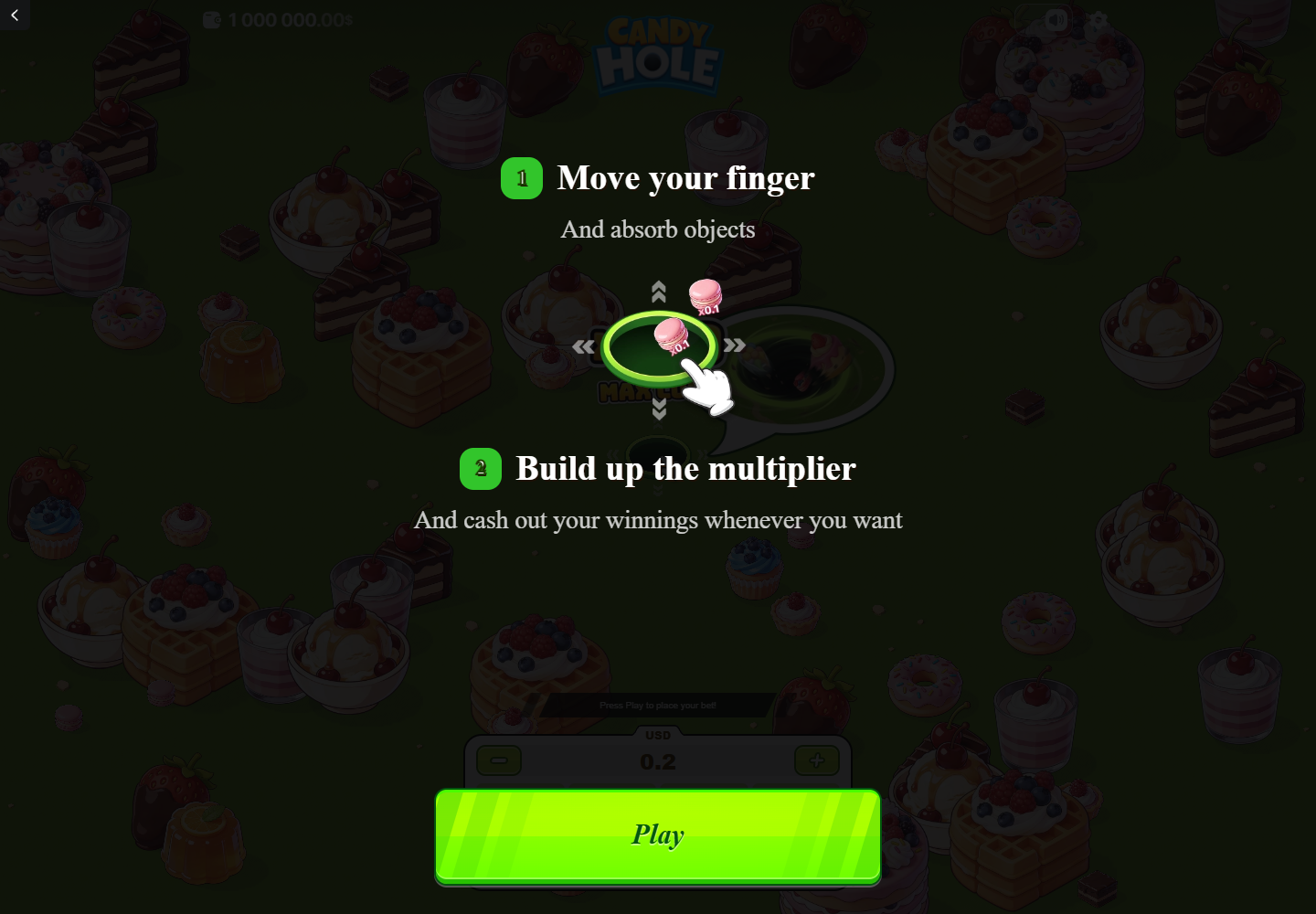
On a desktop screen, the game fills a wide landscape viewport and leaves room for many dessert objects around the central hole. Mouse dragging performs the same directional action illustrated by the tutorial hand. The wide field makes large cakes and waffles visible at the edges while the logo, balance, sound and settings controls remain at the top.
The bet panel is wider than it is on a phone, but its structure does not change: currency, selected amount, quick values and Play. During the round, Withdraw remains centred along the lower edge. This consistent placement allows the desktop version to add field space without changing the core control sequence.
The portrait mobile view uses the instruction “Move your finger” literally. Direction arrows surround the illustrated hole and a hand icon demonstrates dragging across the screen. The Play button expands across most of the phone width, while the amount panel and quick stake values remain stacked above it.
Touch movement is the primary interaction during an active mobile round. The game avoids small directional buttons and lets the field respond directly to a finger path. This leaves the upper part of the screen for the logo, balance and settings, with the bottom reserved for the stake panel before play and the Withdraw control during play.
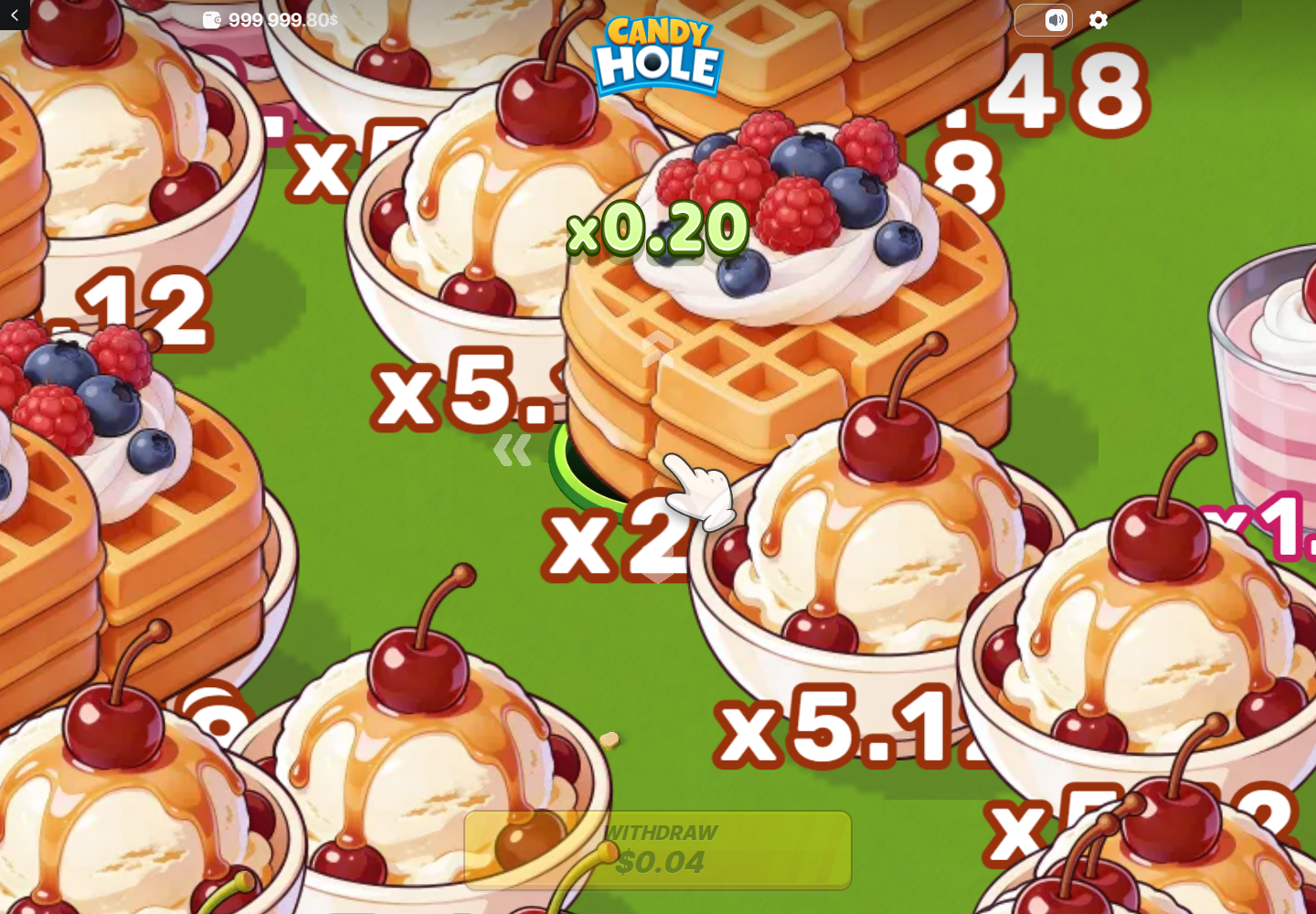
The tutorial states that the player can cash out whenever desired, and the live interface supports that message with a large Withdraw control fixed near the bottom. In the captured movement state, the button shows a current value of $0.04 while the running coefficient appears above the hole and object labels remain visible across the field.
Keeping Withdraw in a stable position is important because the scene beneath it is constantly changing. The control does not move with the hole and remains accessible while the field is being dragged. Its amount provides a direct summary of the active result, allowing the live board and the cash-out action to be read at the same time.
Sound and settings icons appear in the upper-right area of the desktop game and the top bar of the mobile layout. Their position keeps utility actions away from the moving hole and the lower Play or Withdraw button. A back control is placed at the opposite edge, separating navigation from in-game configuration.
These compact icon controls do not need large text labels inside the game canvas because their symbols are familiar. Their containers remain visible over the green field and dark tutorial overlay. Candy-Hole.com describes them as interface features while the exact options inside the settings panel remain part of the live game version.
Candy Hole has four clearly different interface states. The loading screen uses a blue background, floating sweets, the centred logo and a percentage bar. The tutorial darkens the game field and overlays movement instructions. The stake state restores full colour and adds amount controls, while the live round removes the panel and activates Withdraw.
These transitions help the player understand where an action belongs. Loading has no game controls, the tutorial has one Play button, stake selection offers amount controls, and the active field uses movement plus Withdraw. Screenshots from each state are distributed across the site so the complete interface can be inspected without treating one frame as the entire product.
Movement feedback appears through the hole position, changing object arrangement, coefficient labels and running value. In the captured live state, desserts occupy much of the field while the green x0.20 display sits near the centre and the Withdraw amount updates below. The hand pointer reinforces the direction of the current drag.
This feedback makes the round understandable without a separate event log. The player sees the active field and result together. Contrasting number outlines remain legible over large waffles and ice-cream bowls, while the fixed Withdraw control anchors the interface when the camera view becomes visually dense.
Candy-Hole.com separates Gameplay, Multipliers, Controls, Mobile and Features because each page covers a different part of the product. Gameplay follows the round sequence, Multipliers focuses on visible coefficients and Withdraw, Controls documents the stake panel, Mobile compares touch layouts, and Features covers art, loading and utility actions.
Internal links connect those pages without repeating a generic casino catalogue. Screenshots are placed at the beginning, middle and end of the content, each with descriptive alternative text. The result is a focused product information site based on the supplied Candy Hole example rather than a review or a development tutorial.
The partner page opens in a new tab with its current game interface and account options.